INDUSTRIAL PRODUCT
Toaster Plastic Cord Guard Mould and Moulding Services
₹20.00
Toaster Plastic Cord Guard Mould and Moulding Services | Renovator Appliances Ltd
Product Overview
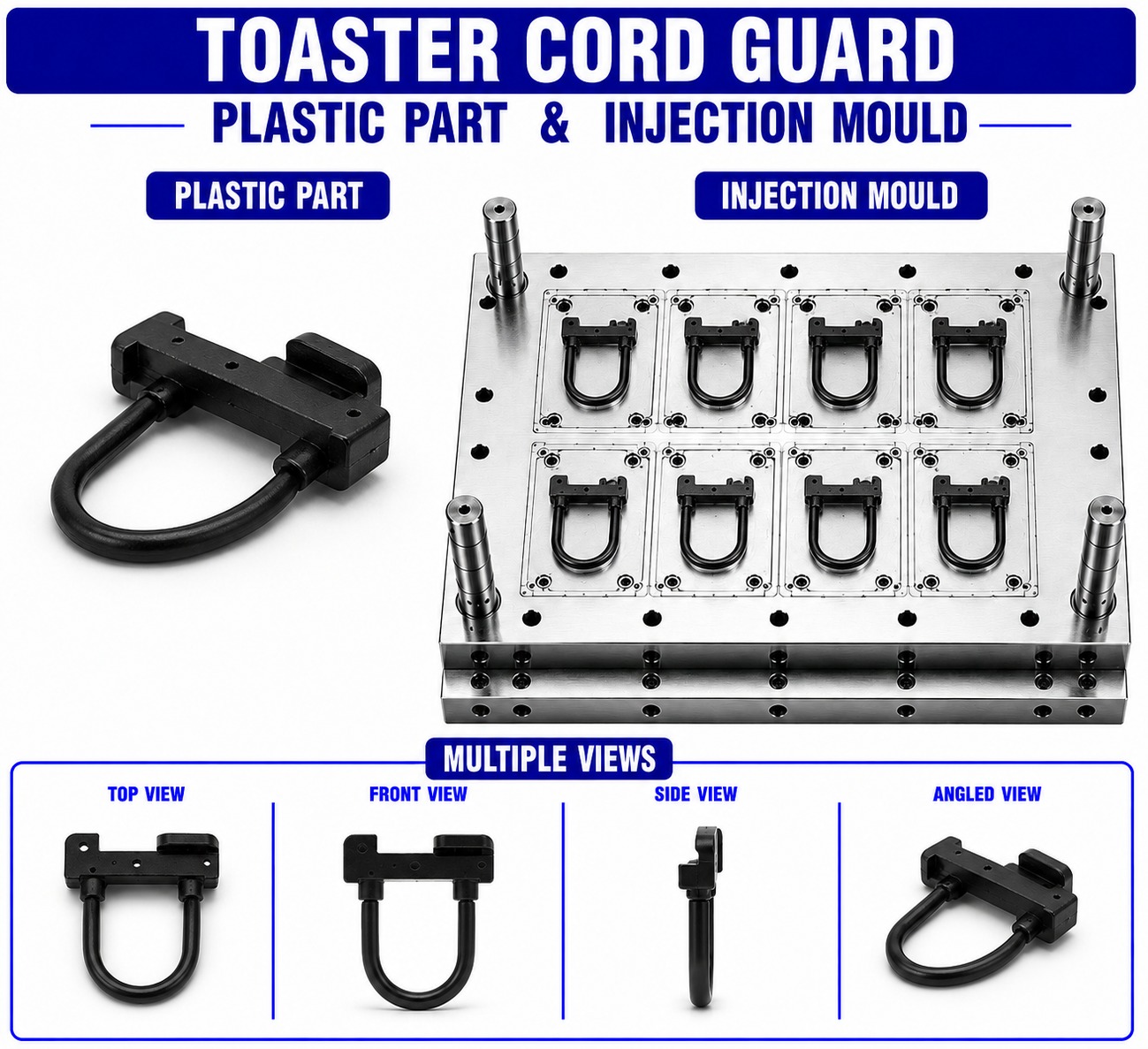
Toaster Plastic Cord Guard is a precision injection-moulded component designed to protect and guide the power cord where it enters or passes through the toaster housing. It helps reduce excessive bending, rubbing, and mechanical stress on the cord while providing a neat and secure cable-routing interface.
The cord guard can be customized according to the power-cord diameter, guard length, wall thickness, mounting arrangement, cable-entry geometry, bend radius, and toaster housing design. It can include retaining clips, locating ribs, cable channels, snap-fit features, mounting sections, and strain-relief geometry according to the product design.
Renovator Appliances Ltd provides complete Toaster Plastic Cord Guard Mould and Moulding Services, including product development, CAD-based mould design, precision mould manufacturing, mould trials, plastic injection moulding, dimensional inspection, assembly validation, functional testing, and bulk OEM production.
Key Features
The Toaster Plastic Cord Guard is designed to provide controlled cable routing and protection at the cord-entry area.
The component can incorporate cable channels, retaining features, mounting clips, locating ribs, strain-relief sections, and bend-control geometry according to the toaster assembly.
Its design can be optimized for secure cord positioning, controlled bending, protection against abrasion, reliable housing fitment, and repeated handling.
The cord guard can be customized with different dimensions, colours, textures, surface finishes, and mounting configurations according to customer requirements.
| Feature | Description |
|---|---|
| Product Type | Toaster Plastic Cord Guard |
| Manufacturing Process | Plastic Injection Moulding |
| Material | Engineering Plastic |
| Design | Customized according to power cord and toaster housing |
| Application | Cord protection, routing and strain relief |
| Surface Finish | Matte, glossy, textured, or customized |
Industrial Applications
The Toaster Plastic Cord Guard can be used in various toaster and kitchen appliance assemblies, including:
Electric Toasters
Pop-Up Toasters
Bread Toasters
Automatic Toasters
Sandwich Toasters
Commercial Toasters
Kitchen Appliances
Small Electrical Appliances
Consumer Appliances
OEM Toaster Assemblies
The exact cord guard design depends on the power-cord diameter, cable-entry location, required bend radius, housing structure, mounting arrangement, operating temperature, and appliance design.
Manufacturing Process
The Toaster Plastic Cord Guard is manufactured through a controlled plastic injection moulding process.
First, the cord guard is designed according to the power-cord dimensions, required bend radius, cable-entry geometry, wall thickness, mounting arrangement, and toaster housing structure. Required cable channels, retaining features, clips, locating ribs, and strain-relief sections are incorporated into the CAD model.
A suitable thermoplastic material is selected according to the required mechanical strength, flexibility, dimensional stability, abrasion resistance, and operating temperature.
The plastic material is heated and injected into the precision mould cavity. The mould forms the cord guard profile, cable passage, retaining features, mounting sections, locating ribs, and strain-relief geometry.
After filling and packing, controlled cooling is applied to minimize shrinkage and warpage. The mould then opens and the finished guard is ejected.
The moulded component is inspected for overall dimensions, cable clearance, mounting accuracy, cord fitment, surface finish, flash, warpage, and complete toaster assembly compatibility.
Mould Manufacturing Process
The Toaster Plastic Cord Guard Mould is designed according to the guard dimensions, cord diameter, cable-entry geometry, wall thickness, mounting arrangement, production volume, selected material, and expected mould life.
The mould incorporates the required cavity, core, parting line, gating system, cooling channels, and ejection mechanism.
Special attention is given to the cable passage, thin-wall sections, retaining features, mounting points, and strain-relief geometry, as these features influence mould filling, dimensional accuracy, cooling, and final assembly performance.
For cord guard designs containing undercuts, snap-fit features, or complex cable-routing geometry, suitable slides, lifters, or mould inserts can be incorporated.
Mould components are manufactured using CNC machining, EDM, drilling, grinding, and precision finishing. After mould assembly, trial moulding is performed using the selected plastic material.
Trial components are checked for cord clearance, cable fitment, mounting dimensions, retaining features, wall thickness, warpage, flash, surface finish, and complete toaster assembly fitment before production approval.
Raw Materials
The material for a Toaster Plastic Cord Guard should provide suitable mechanical strength, durability, dimensional stability, and resistance to repeated cable movement.
Depending on the application, Nylon (PA), PBT, PP, TPE/TPU, ABS, or other suitable engineering plastics can be considered.
Nylon and PBT can provide good mechanical and dimensional performance, while flexible TPE or TPU grades may be considered where greater flexibility and cable-bending protection are required.
Where the cord guard is located near heat-generating components, an appropriate heat-resistant or flame-retardant material grade can be selected according to the customer's technical requirements.
The final material should be selected according to the cord diameter, required flexibility, bend cycles, operating temperature, abrasion requirements, dimensional tolerances, and customer specifications.
Quality Control
Quality control for the Toaster Plastic Cord Guard focuses on dimensional accuracy, cable fitment, mounting security, flexibility where required, and assembly compatibility.
The finished guard can be checked for overall length, width, height, cable-passage diameter, wall thickness, mounting dimensions, retaining features, bend clearance, and housing interface dimensions according to the approved drawing.
The moulded component is also inspected for flash, short shots, sink marks, cracks, warpage, burrs, weld lines, flow marks, and other moulding defects.
Assembly testing can be performed using the actual power cord, toaster housing, cable-entry opening, mounting hardware, and adjoining components to verify:
Secure cord positioning
Proper cable clearance
Controlled cord bending
Reliable mounting
Correct strain relief
Housing fitment
Protection against excessive rubbing
Repeated cable movement performance
Absence of cracking or deformation
Where required, bend-cycle, pull, abrasion, and application-specific functional testing can be performed according to the customer's technical specifications.
Production Capacity
Production capacity depends on the cord guard size, product weight, mould cavity count, cycle time, plastic material, injection moulding machine capacity, mould design, and overall production efficiency.
Because cord guards are generally small components, multi-cavity moulds can be considered for high-volume production.
For example, an 8-cavity mould operating with a 20-second cycle has a theoretical output of approximately 1,440 pieces per hour before inspection, handling, machine downtime, mould maintenance, and other production losses.
Final production capacity should be established according to the actual product weight, cavity count, cycle time, machine capacity, and required monthly production quantity.
Buyer Guide
Before ordering a Toaster Plastic Cord Guard Mould and Moulding Service, the buyer should provide a 2D drawing, 3D CAD model, existing cord guard sample, power cord, toaster housing, cable-entry section, or complete assembly.
Important specifications include power-cord diameter, guard dimensions, cable-passage diameter, wall thickness, required bend radius, mounting arrangement, operating temperature, material, colour, surface finish, dimensional tolerances, and production quantity.
Providing the actual power cord and toaster housing is recommended because the cord guard must provide accurate cable fitment and secure attachment.
Why Choose Renovator?
Renovator Appliances Ltd provides an integrated manufacturing solution for customized cable-routing, cord-protection, strain-relief, mounting, and precision components used in toasters and other kitchen appliances.
For the Toaster Plastic Cord Guard, our service covers the complete process from product development and component design to mould design, precision mould manufacturing, plastic injection moulding, dimensional inspection, assembly validation, functional testing, and bulk OEM production.
The cord guard can be developed according to the customer's actual toaster assembly, including specific cord diameter, cable passage, bend radius, mounting features, material grade, colour, surface finish, tolerances, and production quantity.
This integrated approach helps maintain consistency between the cord guard, power cord, toaster housing, cable-entry structure, mounting hardware, mould, plastic material, and final toaster assembly.
Frequently Asked Questions (FAQ)
1. What is a Toaster Plastic Cord Guard?
A Toaster Plastic Cord Guard is a moulded component used to guide and protect the power cord where it enters or passes through the toaster housing.
2. Which materials are suitable for a Toaster Plastic Cord Guard?
Depending on the application, Nylon, PBT, PP, TPE/TPU, ABS, or suitable engineering plastics can be considered. Material selection depends on flexibility, temperature, abrasion resistance, dimensional stability, and mechanical requirements.
3. Can the Toaster Plastic Cord Guard be customized?
Yes. The cord guard can be customized according to cord diameter, length, cable passage, bend radius, mounting arrangement, flexibility, colour, material, and surface finish.
4. Can the Toaster Plastic Cord Guard be manufactured using a multi-cavity mould?
Yes. Multi-cavity moulds can be designed according to the required production volume, component size, cycle time, machine capacity, and customer requirements.
5. Can Renovator manufacture both the Cord Guard mould and finished components?
Yes. Renovator provides complete mould manufacturing and moulding services, including mould trials, dimensional inspection, assembly validation, functional testing, and bulk production according to customer requirements.
- SKU
- REN-7FFE9785EEBC244B5761A85D