INDUSTRIAL PRODUCT
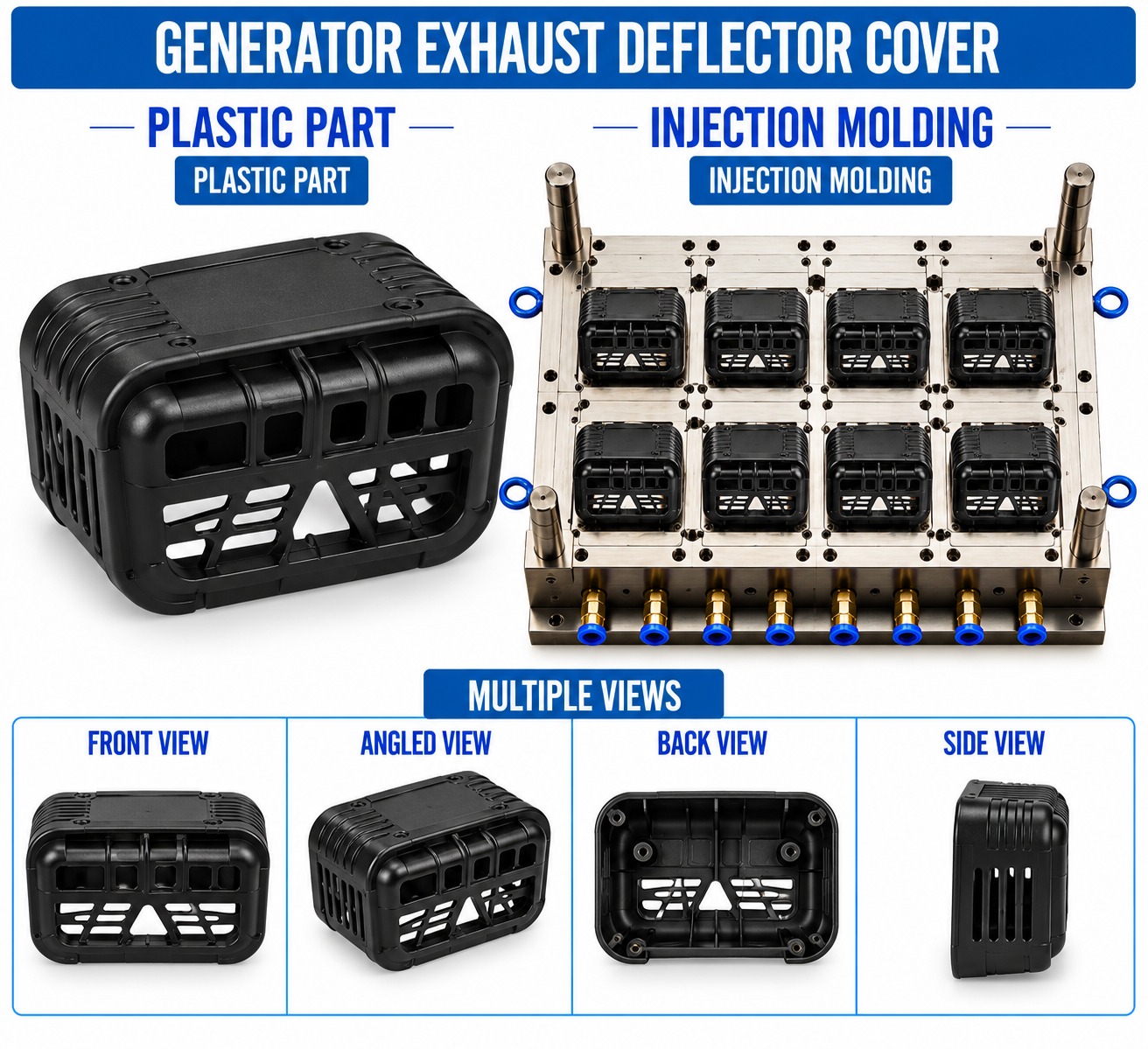
Generator Plastic Exhaust Deflector Cover Mould and Moulding Service
₹100.00
Generator Plastic Exhaust Deflector Cover Mould and Moulding Service | Renovator Appliances Ltd
Product Overview
Renovator Appliances Ltd manufactures Generator Plastic Exhaust Deflector Cover Mould and Moulding Service for exhaust-area components designed to help guide or redirect exhaust flow away from selected parts of the generator assembly. The deflector cover can also provide a defined protective structure around the exhaust outlet and help reduce direct exposure of nearby panels, wiring, or other components to the exhaust discharge path.
The mould is developed according to the exhaust outlet diameter, deflector geometry, airflow direction, mounting arrangement, wall thickness, clearance from hot exhaust components, and available installation space. Because the component is positioned near a heat source, material and design selection must be based on the actual temperature and operating conditions of the generator.
Key Features
Application-specific exhaust deflector geometry
Controlled exhaust-flow direction
Accurate exhaust outlet and inlet interface
Proper clearance from hot exhaust components
Secure mounting and locating features
Controlled wall thickness for dimensional stability
Integrated ribs or reinforcement where required
Smooth edges around exhaust-flow areas
Consistent fitment with the generator exhaust assembly
Suitable for customized OEM generator designs
Industrial Applications
| Application Area | Function |
|---|---|
| Portable Generators | Helps redirect exhaust discharge away from selected areas |
| Industrial Generator Sets | Supports controlled exhaust-deflection arrangements |
| Standby Generators | Helps manage the direction of exhaust discharge |
| Compact Generator Assemblies | Provides a defined deflector structure around the exhaust outlet |
| OEM Generator Systems | Customized according to exhaust geometry and mounting requirements |
Manufacturing Process
1. Product Design & Development
The Generator Plastic Exhaust Deflector Cover is designed around the exhaust outlet dimensions, required flow direction, mounting points, surrounding components, and available clearance. The design considers the component's proximity to the exhaust system, including thermal exposure, vibration, airflow path, and potential contact with adjacent generator parts.
2. Plastic Mould Design
The mould is engineered to reproduce the required deflector profile, exhaust passage, mounting bosses, screw holes, clips, locating features, and reinforcement ribs. Draft angles, ejection points, cooling, and gate locations are considered to maintain dimensional stability and minimize warpage.
Where the deflector operates close to a high-temperature exhaust component, the final polymer selection and thermal protection arrangement should be validated against the actual operating temperature rather than assuming that a general-purpose plastic is suitable.
3. Mould Manufacturing
The mould is manufactured using suitable mould steel such as P20, H13, or S136 according to production volume, required surface finish, plastic material, and expected mould life. CNC machining, EDM, drilling, polishing, fitting, and mould trials are performed to achieve the required cavity accuracy.
4. Injection Moulding
The selected plastic material is processed through controlled injection moulding conditions. Melt temperature, injection pressure, holding pressure, cooling time, and cycle parameters are adjusted according to the selected polymer and component geometry to achieve consistent dimensions and stable deflector profiles.
5. Finishing & Assembly Preparation
After moulding, gates and flash are removed and edges are finished as required. Mounting features and exhaust-flow openings are checked before the component is prepared for installation with the generator exhaust assembly.
6. Quality Inspection
Finished deflector covers are inspected for dimensional accuracy, exhaust-passage geometry, mounting position, wall thickness, surface quality, and fitment with the generator exhaust system. Thermal and airflow validation can be performed when required by the application.
Raw Materials
| Material | Application Consideration |
|---|---|
| High-Temperature Engineering Plastic | Considered where the component experiences elevated operating temperatures |
| Glass-Filled Nylon / PA | May be considered where increased mechanical and dimensional stability is required |
| Heat-Resistant PC+ABS | Considered only where its temperature capability is suitable for the actual application |
| Flame-Retardant Engineering Plastic | May be selected where additional flame-resistance characteristics are required |
| Specialized High-Temperature Polymer | Considered for applications with higher thermal exposure |
Material selection should be based on measured or specified exhaust-area temperatures, heat exposure duration, mechanical loading, vibration, airflow, and applicable safety requirements. A standard plastic grade should not be used near the exhaust solely based on its general mechanical properties.
Quality Control
Renovator Appliances Ltd checks the Generator Plastic Exhaust Deflector Cover for:
Overall dimensions and deflector profile
Exhaust inlet and outlet geometry
Flow-path alignment
Mounting-hole and boss positions
Internal clearance from exhaust components
Wall thickness consistency
Rib and reinforcement geometry
Generator exhaust assembly fitment
Warpage and dimensional deformation
Flash, sink marks, short shots, and moulding defects
Surface finish and edge quality
Mounting security
Thermal clearance and heat-exposure requirements
Airflow or exhaust-deflection performance where required
Buyer Guide
Before ordering a Generator Plastic Exhaust Deflector Cover mould and moulding service, buyers should provide the exhaust outlet diameter, required deflection direction, mounting arrangement, surrounding component dimensions, available clearance, material requirements, operating temperature information, generator model specifications, and production quantity.
Special attention should be given to the distance between the plastic deflector and the exhaust manifold, muffler, pipe, or outlet. If temperatures are high, a heat shield, thermal barrier, alternative material, or different component construction may be required rather than relying on conventional plastic alone.
Why Choose Renovator Appliances Ltd?
Advanced Injection Moulding Facility
Controlled injection moulding processes support consistent deflector geometry, mounting accuracy, wall thickness, and repeatable production quality.
In-House Mould Manufacturing
Mould development can be coordinated with the exhaust deflector's flow path, mounting features, clearances, and customized geometry.
OEM & ODM Manufacturing
Customized exhaust deflector covers can be manufactured according to OEM drawings, samples, exhaust dimensions, and generator-specific requirements.
Quality Assurance
Dimensional inspection, visual checks, assembly-fit verification, and application-specific thermal or functional validation support reliable component production.
Cost-Effective Manufacturing
Integrated mould manufacturing and injection moulding services help streamline customized exhaust deflector production for prototype development and volume requirements.
Frequently Asked Questions
1. What is a Generator Plastic Exhaust Deflector Cover used for?
It is designed to guide or redirect exhaust discharge and can provide a defined protective structure around the exhaust outlet, depending on the generator design.
2. Can the exhaust deflector cover be customized?
Yes. The component can be customized according to exhaust outlet dimensions, deflection direction, mounting points, surrounding clearances, shape, colour, material, and generator configuration.
3. Can ordinary ABS or PP be used for an exhaust deflector cover?
Not necessarily. The suitability of ABS, PP, or any other polymer depends on the actual temperature and duration of heat exposure. A heat-resistant material or alternative construction may be required for high-temperature locations.
4. Which mould steel can be used for manufacturing the mould?
P20, H13, or S136 steel can be selected according to production volume, required surface finish, plastic material, and expected mould service life.
5. Can Renovator Appliances Ltd manufacture both the mould and the plastic exhaust deflector cover?
Yes. The service can include mould design and manufacturing followed by injection moulding of the Generator Plastic Exhaust Deflector Cover according to the required application specifications.
- SKU
- REN-C777B6428A7FE27FC5AAD062