INDUSTRIAL PRODUCT
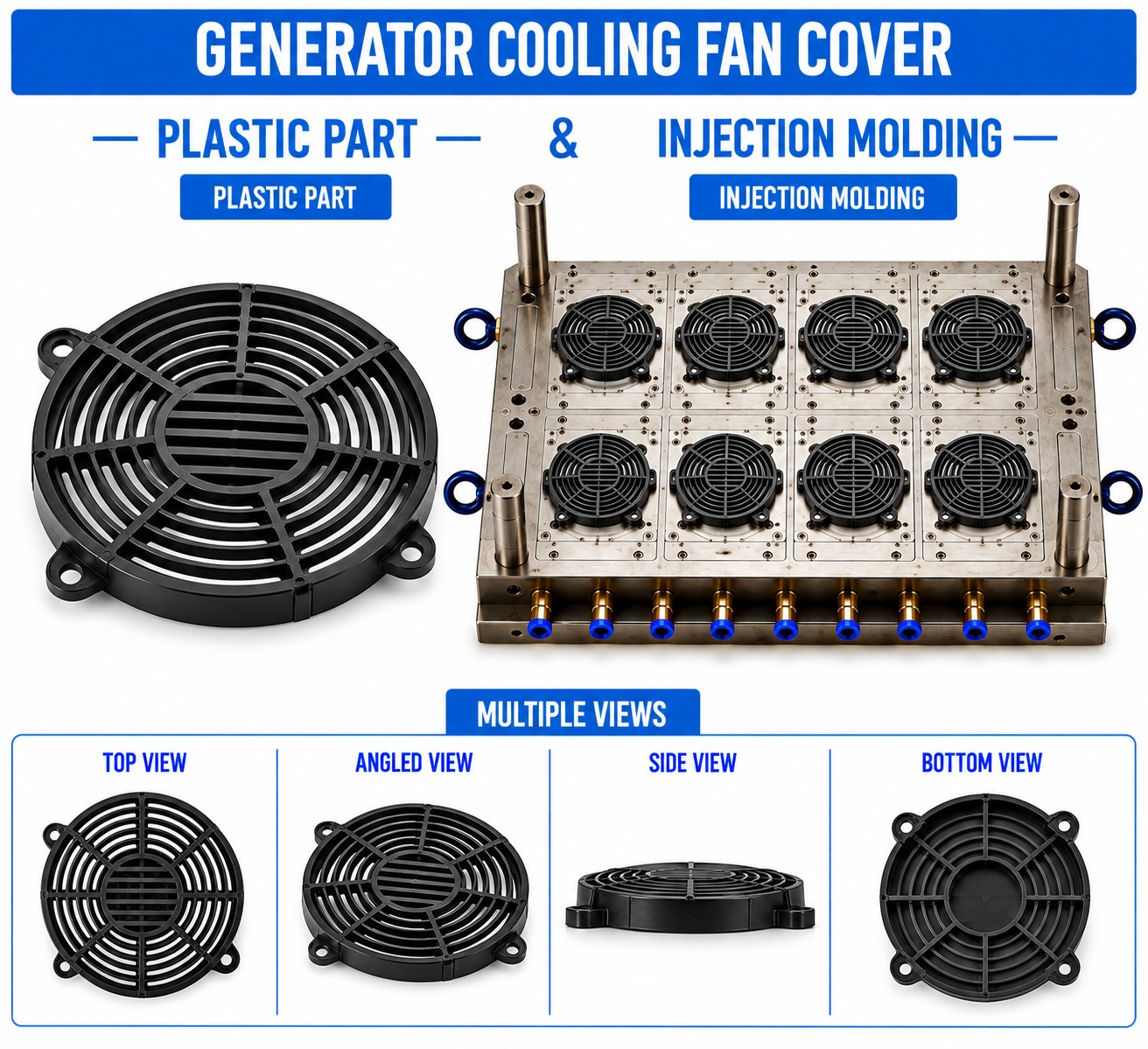
Generator Plastic Cooling Fan Cover Mould and Moulding Service
₹100.00
Generator Plastic Cooling Fan Cover Mould and Moulding Service | Renovator Appliances Ltd
Product Overview
Renovator Appliances Ltd manufactures Generator Plastic Cooling Fan Cover Mould and Moulding Service for protective and airflow-management applications around generator cooling fan assemblies. The cover is designed to provide the required clearance around the rotating fan while helping direct airflow and protecting the fan area from accidental contact, dust, and external interference.
The mould is developed according to the cooling fan diameter, blade clearance, mounting arrangement, airflow requirements, surrounding engine or alternator geometry, and available installation space. Injection moulding provides consistent concentricity, mounting accuracy, wall thickness, and repeatable production quality for generator OEM applications.
Key Features
Application-specific cooling fan cover design for generator assemblies
Accurate internal clearance around rotating fan blades
Controlled circular or profiled geometry for proper fan alignment
Ventilation openings or grille sections according to airflow requirements
Strong mounting bosses, holes, clips, or retaining features
Reinforced ribs to improve cover rigidity without excessive material usage
Controlled wall thickness for dimensional stability
Smooth edges around airflow and access openings
Designed to minimize interference with rotating components
Material selection based on temperature, vibration, impact, and environmental exposure
Suitable for OEM and customized generator production
Industrial Applications
| Application Area | Use of Cooling Fan Cover |
|---|---|
| Generator Cooling Assembly | Provides protective enclosure around the cooling fan |
| Engine Compartment | Helps protect the fan area from external contact and debris |
| Alternator Cooling System | Supports controlled airflow around cooling components |
| Portable Generators | Provides compact fan protection and airflow management |
| Standby Generators | Supports durable protective enclosure requirements |
| OEM Generator Manufacturing | Enables repeatable production of application-specific fan covers |
Manufacturing Process
1. Product Design & Development
The component is developed according to the cooling fan diameter, blade height, rotational clearance, mounting points, airflow direction, surrounding components, and installation space. The design maintains sufficient clearance from the rotating fan to prevent contact during normal operation and expected vibration.
2. Plastic Mould Design
The injection mould is designed around the fan-cover profile, circular clearance zone, ventilation openings, ribs, mounting bosses, clips, and fastening interfaces. Gate placement, cooling channels, venting, and ejection points are optimized to reduce warpage and maintain the required concentricity and mounting dimensions.
3. Mould Manufacturing
The mould can be manufactured using P20, H13, or S136 Steel, depending on production volume, material selection, surface-finish requirements, and expected mould life. CNC machining, EDM, polishing, mould fitting, and trial runs are used to achieve the required cavity geometry.
4. Injection Moulding
The selected plastic is processed using controlled injection pressure, melt temperature, holding pressure, cooling time, and cycle parameters. Process conditions are optimized to maintain the fan clearance, ventilation openings, mounting interfaces, and overall profile consistently across production batches.
5. Finishing & Assembly Preparation
Moulded cooling fan covers are inspected and trimmed to remove unwanted gate remnants or flash. Vent openings, mounting holes, clips, and fan-clearance areas are checked to ensure that the finished component is ready for assembly.
6. Quality Inspection
Critical dimensions such as fan diameter clearance, concentricity, mounting-hole position, overall height, wall thickness, ventilation opening dimensions, and adjacent-component clearances are inspected. Assembly trials can be performed with the corresponding generator fan and housing.
Raw Materials
| Material | Application Consideration |
|---|---|
| PP | Suitable for many lightweight fan-cover applications where temperature and mechanical requirements permit |
| ABS | Suitable where rigidity, dimensional stability, and impact resistance are required |
| PA / Nylon | Can be considered for applications requiring higher temperature and mechanical performance |
| Glass-Filled Nylon | Suitable where increased stiffness and dimensional stability are required |
| PC+ABS | Can be considered where higher impact performance and dimensional stability are required |
| Flame-Retardant Engineering Plastic | Considered where the generator design requires enhanced resistance to ignition or flame propagation |
The final material should be selected after evaluating actual operating temperature, vibration, fan-generated airflow, surrounding heat sources, impact requirements, and applicable safety requirements.
Quality Control
Cooling fan diameter and clearance inspection
Concentricity and alignment verification
Mounting-hole and boss-position inspection
Ventilation-opening dimensional inspection
Wall-thickness consistency checks
Warpage and deformation inspection
Flash and gate-mark inspection
Surface-finish inspection
Fan-to-cover interference verification
Assembly fitment testing
Vibration and temperature validation
Batch-to-batch dimensional consistency monitoring
Buyer Guide
When sourcing a Generator Plastic Cooling Fan Cover, buyers should provide the fan diameter, blade dimensions, required clearance, mounting-hole locations, ventilation requirements, surrounding component dimensions, operating temperature, vibration conditions, and production quantity.
For new development, a 2D drawing, 3D CAD model, existing sample, or complete fan assembly can be used to establish the required mould geometry. The final design should provide adequate clearance under operating and vibration conditions rather than relying only on static fitment.
Why Choose Renovator Appliances Ltd?
Advanced Injection Moulding Facility
Renovator Appliances Ltd uses controlled injection moulding processes to manufacture cooling fan covers with consistent dimensions, airflow openings, mounting features, and surface quality.
In-House Mould Manufacturing
In-house mould manufacturing provides control over cavity geometry, cooling, ejection, mould fitting, and production trials for application-specific generator components.
OEM & ODM Manufacturing
Customized mould and moulding solutions can be developed according to OEM drawings, samples, fan assemblies, and functional requirements.
Quality Assurance
Dimensional inspection, assembly verification, visual inspection, and application-specific validation help maintain reliable fan-cover quality.
Cost-Effective Manufacturing
Optimized mould design, cavity configuration, material selection, and injection parameters support economical production for prototype development and volume manufacturing.
Frequently Asked Questions
1. What is a Generator Plastic Cooling Fan Cover used for?
It provides protective coverage around a generator cooling fan while maintaining the required clearance and ventilation for proper cooling-system operation.
2. How is the cooling fan clearance determined?
Clearance is determined from the fan diameter, blade height, rotational movement, surrounding structure, vibration, thermal expansion, and operating conditions of the generator assembly.
3. Which plastic material is suitable for a cooling fan cover?
PP, ABS, Nylon, Glass-Filled Nylon, PC+ABS, or a suitable flame-retardant engineering plastic may be considered depending on temperature, vibration, impact, and safety requirements.
4. Can the cooling fan cover include ventilation grilles?
Yes. Ventilation slots, grille patterns, ribs, or openings can be incorporated according to the required airflow and protective requirements.
5. Can the mould be developed from an existing fan cover sample?
Yes. A physical sample, 2D drawing, 3D CAD model, or complete fan assembly can be used as a reference for developing the mould and verifying the final fitment.
- SKU
- REN-7F1A7622455764B44FD7DD16