- Home
- About us
- Plastic Products and Moulds+
- Steam Iron Plastic Parts Mould and Moulding Services
- Plastic Injection Moulding Services
- Industrial Plastic Crates and Moulds
- Air Conditioner Plastic Parts And Moulds
- Printer Plastic Parts and Moulds
- Laptop Plastic Parts And Moulds
- Vacuum Cleaner Plastic Parts and Moulds
- Air Cooler Plastic Parts and Moulds
- Water Dispenser Plastic Parts and Moulds
- Washing Machine Plastic Parts And Moulds
- Water Purifier Plastic Parts and Moulds
- Robot Plastic Parts Mould and Moulding Services
- CPU Plastic Parts and Moulds
- Refrigerator Plastic Parts and Moulds
- Air Blower Plastic Parts Mould and Moulding Services
- Food Processor Plastic Parts and Moulds
- Lawn Mower Plastic Parts Mould and Moulding Services
- Microwave Oven Plastic Parts Mould and Moulding Services
- Monitor Plastic Parts and Moulds
- Mixer Grinder Plastic Parts Mould and Moulding Services
- Chimney Plastic Parts Mould and Moulding Services
- Geyser Plastic Parts Mould and Moulding Services
- Humidifier Plastic Parts Mould and Moulding Services
- Home Theatre Plastic Parts Mould and Moulding Services
- Steam Mop Plastic Parts Mould and Moulding Services
- Toaster Plastic Parts Mould and Moulding Services
- Egg Boiler Plastic Parts Mould and Moulding Services
- Air Purifier Plastic Parts Mould and Moulding Services
- Hair Straightener Plastic Parts Mould and Moulding Services
- Coffee Maker Plastic Parts Mould and Moulding Services
- Inverter Plastic Parts Mould and Moulding Services
- Air Fryer Plastic Parts Mould and Moulding Services
- Garment Steamer Plastic Parts Mould and Moulding Services
- Hair Dryer Plastic Parts Mould and Moulding Services
- Room Heater Plastic Parts Mould and Moulding Services
- Electric Rice Cooker Plastic Parts Mould and Moulding Services
- Air Curtain Plastic Parts Mould and Moulding Services
- Electric Tandoor Plastic Parts Mould and Moulding Services
- Popcorn Maker Plastic Parts Mould and Moulding Services
- Set Top Box Plastic Parts Mould and Moulding Services
- Floor Scrubber Plastic Parts Mould and Moulding Services
- Electric Upholstery Plastic Parts Mould and Moulding Services
- Automatic Pet Feeder Plastic Parts Mould and Moulding Services
- Electric Flour Mill Plastic Parts Mould and Moulding Services
- Electric Face Steamer Plastic Parts Mould and Moulding Services
- Contact us
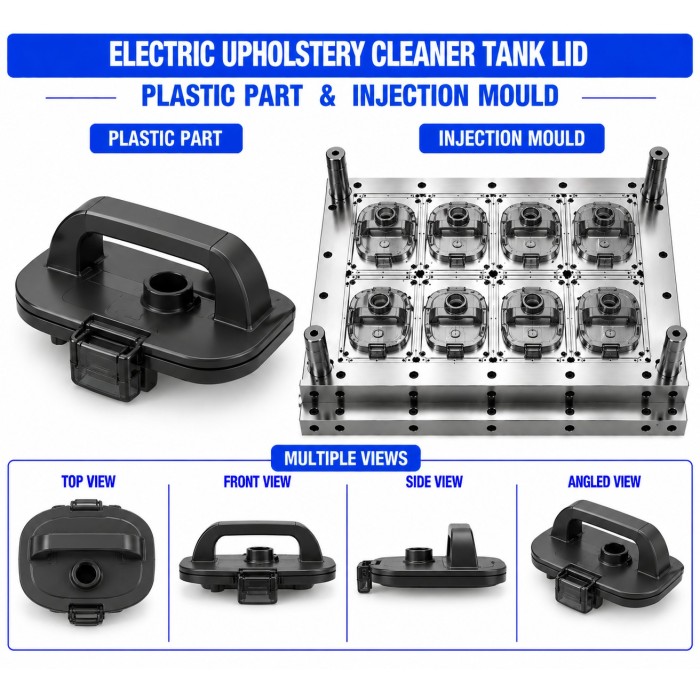
Electric Upholstery Cleaner Plastic Tank Lid Mould and Moulding Service
EUCPTL
Rs. 180.00
/ Piece (1 Piece) Electric Upholstery Cleaner Plastic Tank Lid Mould and Moulding Service | Renovator Appliances Ltd
Product Overview
Renovator Appliances Ltd. provides Electric Upholstery Cleaner Plastic Tank Lid Mould and Moulding Service for manufacturing precision-moulded plastic tank lids used in electric upholstery cleaners, spot cleaners, carpet cleaning machines, and compact fabric cleaning equipment. The tank lid is designed to provide secure coverage for the machine's water or recovery tank while supporting proper sealing, access, filling, inspection, and integration with the cleaning system.
The tank lid can be developed according to the tank dimensions, lid opening, sealing arrangement, handle or grip requirements, ventilation provisions, hose or connector interfaces, locking mechanism, mounting method, and surrounding machine structure. Injection moulding supports consistent dimensions, accurate sealing surfaces, repeatable locking features, and reliable fitment with the specified tank.
Key Features
Application-specific tank lid design
Customized according to electric upholstery cleaner tank dimensions
Secure coverage for clean-water or recovery-water tanks
Suitable for removable or fixed tank arrangements
Provision for sealing grooves, gasket interfaces, and sealing surfaces
Locking clips, tabs, latches, screw posts, and locating features
Handle or grip provisions where required
Hose, vent, valve, or connector openings where required
Reinforced areas for improved structural support
Suitable for different colours, textures, and surface finishes
Controlled wall thickness for consistent moulding
Designed for repeated tank opening and closing
Consistent dimensions for repeatable assembly
Suitable for OEM, ODM, and customized upholstery cleaner designs
Industrial Applications
| Application Area | Use of Tank Lid |
|---|---|
| Electric Upholstery Cleaners | Coverage and access for water or recovery tanks |
| Portable Spot Cleaners | Secure tank closure and filling access |
| Carpet Cleaning Machines | Tank protection and sealing |
| Fabric Cleaning Equipment | Clean-water or recovery-tank coverage |
| Compact Wet Cleaning Machines | Removable tank lid applications |
| Commercial Upholstery Cleaning Equipment | Durable tank closure applications |
| OEM Cleaning Equipment | Customized tank lid production |
Manufacturing Process
1. Product Design & Development
The tank lid is developed according to the tank dimensions, opening size, water or recovery-tank arrangement, sealing requirements, locking mechanism, handle position, and available machine space. Lid wall thickness, sealing surfaces, gasket interfaces, mounting features, clips, locating points, and surrounding component clearances are evaluated during product development.
2. Plastic Mould Design
The injection mould is designed according to the tank lid geometry and required sealing grooves, gasket interfaces, clips, latches, tabs, bosses, ribs, handles, locating features, and openings. The cavity, core, parting line, gate location, runner system, cooling channels, venting, and ejection arrangement are planned to support accurate formation of the tank lid.
Special attention can be given to sealing surfaces, draft angles, wall-thickness consistency, shrinkage, warpage control, and mould release requirements to support reliable production.
3. Mould Manufacturing
The mould can be manufactured using suitable tool steel such as P20 Steel, H13 Steel, or S136 Steel, depending on production volume, required mould life, dimensional requirements, and surface finish. CNC machining, EDM, grinding, polishing, fitting, and mould trials are performed as required.
4. Injection Moulding
The selected thermoplastic material is heated and injected into the mould cavity under controlled processing conditions. Injection pressure, melt temperature, holding pressure, cooling time, and cycle time are adjusted according to the selected material and tank lid geometry to support consistent production.
Processing parameters are controlled to help achieve accurate sealing surfaces, locking features, mounting points, uniform filling, suitable surface quality, and reduced warpage.
5. Finishing & Assembly Preparation
After moulding, gates and excess plastic are removed where applicable. Sealing grooves, gasket interfaces, locking clips, latches, handles, mounting features, ventilation openings, and lid edges are inspected and finished as required before assembly.
Where applicable, the lid can be checked with the specified tank to verify proper closing, locking, sealing, and removal.
6. Quality Inspection
Finished tank lids are inspected for dimensional accuracy, sealing surfaces, locking features, mounting points, surface quality, warpage, flash, and proper fitment with the intended upholstery cleaner tank.
Raw Materials
| Material | Typical Application |
|---|---|
| PP | Lightweight tank lids requiring suitable flexibility and moisture resistance |
| HDPE | Tank lid applications requiring good moisture and chemical resistance |
| ABS | Rigid lids requiring good surface appearance |
| HIPS | Economical tank lid applications |
| PC+ABS | Applications requiring a balance of strength, impact resistance, and appearance |
| PBT | Applications requiring dimensional and thermal stability |
| Nylon / PA | Applications requiring higher mechanical strength |
| Glass-Filled Nylon | Structural lid applications requiring increased stiffness |
| ASA | Applications requiring suitable weather and UV resistance |
| Flame-Retardant Plastic | Applications requiring enhanced fire-performance characteristics, subject to specification |
| Engineering Plastic | Applications requiring specific mechanical, thermal, chemical, or environmental properties |
The final plastic grade should be selected according to water or cleaning-solution compatibility, chemical exposure, operating temperature, impact requirements, vibration, repeated opening and closing, sealing requirements, mounting loads, and expected service life. Material compatibility should be verified against the actual cleaning chemicals intended for use in the upholstery cleaner.
Quality Control
Raw Material Inspection: Plastic grade, colour, and incoming material condition are checked before production.
Mould Inspection: Cavity, core, tank lid geometry, sealing features, locking features, mounting areas, cooling system, venting, and ejection system are inspected.
Dimensional Inspection: Overall dimensions, wall thickness, tank opening dimensions, sealing surfaces, mounting points, and critical interfaces are checked.
Visual Inspection: Components are inspected for flash, short shots, sink marks, warpage, scratches, burn marks, flow marks, and other moulding defects.
Tank Fitment Inspection: The lid is checked for correct fitment with the specified tank opening and surrounding machine structure.
Sealing Inspection: Sealing surfaces, gasket grooves, sealing interfaces, and contact areas are checked according to the approved design.
Locking Inspection: Clips, latches, tabs, locks, and locating features are checked for proper engagement and release.
Handle Inspection: Where applicable, handle or grip features are checked for dimensional accuracy, strength, and proper integration with the lid.
Assembly Inspection: The lid is checked for proper opening, closing, removal, installation, and alignment with the tank and associated machine components.
Packaging Inspection: Finished components are protected against scratches, deformation, dust, and handling damage during storage and transportation.
Buyer Guide
When sourcing an Electric Upholstery Cleaner Plastic Tank Lid Mould and Moulding Service, buyers should provide the tank dimensions, tank opening details, 2D engineering drawing or 3D CAD model, sealing arrangement, gasket specifications, locking mechanism, handle requirements, hose or valve openings, mounting arrangement, preferred plastic grade, colour, surface finish, and estimated production quantity.
For new product development, attention should be given to tank fitment, sealing performance, gasket compression, locking strength, repeated opening and closing, chemical compatibility, water exposure, vibration, impact resistance, cleaning chemicals, operating temperature, filling access, and the actual installation position of the tank lid within the upholstery cleaner.
Why Choose Renovator Appliances Ltd?
Advanced Injection Moulding Facility
Our injection moulding capabilities support consistent production of plastic tank lids with repeatable dimensions, sealing surfaces, locking features, mounting points, and surface quality.
In-House Mould Manufacturing
Mould development and manufacturing can be coordinated according to the tank lid geometry, sealing arrangement, locking mechanism, mounting requirements, production volume, and component specifications.
OEM & ODM Manufacturing
Customized tank lids can be developed and manufactured according to customer drawings, CAD models, samples, specifications, or electric upholstery cleaner development requirements.
Quality Assurance
Raw materials, moulds, dimensions, tank fitment, sealing surfaces, locking features, mounting points, surface quality, and assembly interfaces can be inspected throughout the manufacturing process.
Cost-Effective Manufacturing
Optimized mould design, suitable material selection, and controlled injection moulding processes can support economical production for development quantities as well as larger-volume requirements.
Frequently Asked Questions
1. What is an Electric Upholstery Cleaner Plastic Tank Lid?
It is a moulded plastic lid designed to cover and close a clean-water or recovery-water tank in an electric upholstery cleaner while providing the required sealing, locking, filling, and access functions.
2. Which plastic materials can be used for a tank lid?
PP, HDPE, ABS, HIPS, PC+ABS, PBT, Nylon/PA, Glass-Filled Nylon, ASA, suitable flame-retardant plastics, and other engineering plastics can be considered according to the required mechanical, chemical, thermal, and environmental characteristics.
3. Can the tank lid be customized?
Yes. Lid dimensions, sealing grooves, gasket interfaces, locking clips, latches, handles, tabs, ribs, openings, mounting features, colour, texture, and surface finish can be customized according to the upholstery cleaner tank design.
4. Which steel is suitable for the tank lid mould?
P20 Steel, H13 Steel, or S136 Steel can be selected depending on production volume, required mould life, dimensional requirements, and surface finish.
5. Can Renovator Appliances Ltd. provide both mould making and moulding?
Yes. Renovator Appliances Ltd. can support mould development, mould manufacturing, and injection moulding for customized electric upholstery cleaner plastic tank lids, subject to the required design and production specifications.
Electric Upholstery Plastic Parts
Mould Material : P20 Steel / H13 Steel / S136 Steel
Plastic Grade : Impact Resistant / Chemical Resistant / Heat ResistantProduct Material : PP / ABS / HDPEMould Type : Single Cavity / Multi CavityWeight : 100–500 gDimensions : 200–500 × 150–400 × 30–100 mm