- Home
- About us
- Plastic Products and Moulds+
- Plastic Injection Moulding Services
- Industrial Plastic Crates and Moulds
- Air Conditioner Plastic Parts And Moulds
- Printer Plastic Parts and Moulds
- Laptop Plastic Parts And Moulds
- Vacuum Cleaner Plastic Parts and Moulds
- Air Cooler Plastic Parts and Moulds
- Water Dispenser Plastic Parts and Moulds
- Washing Machine Plastic Parts And Moulds
- Water Purifier Plastic Parts and Moulds
- Robot Plastic Parts Mould and Moulding Services
- CPU Plastic Parts and Moulds
- Refrigerator Plastic Parts and Moulds
- Air Blower Plastic Parts Mould and Moulding Services
- Food Processor Plastic Parts and Moulds
- Lawn Mower Plastic Parts Mould and Moulding Services
- Microwave Oven Plastic Parts Mould and Moulding Services
- Monitor Plastic Parts and Moulds
- Mixer Grinder Plastic Parts Mould and Moulding Services
- Chimney Plastic Parts Mould and Moulding Services
- Geyser Plastic Parts Mould and Moulding Services
- Humidifier Plastic Parts Mould and Moulding Services
- Air Purifier Plastic Parts Mould and Moulding Services
- Home Theatre Plastic Parts Mould and Moulding Services
- Steam Mop Plastic Parts Mould and Moulding Services
- Contact us
Home Theatre Plastic Tweeter Protector Mould and Moulding Service
HTPTP
Rs. 25.00
/ Piece (1 Piece) Home Theatre Plastic Tweeter Protector Mould and Moulding Service | Renovator Appliances Ltd
Product Overview
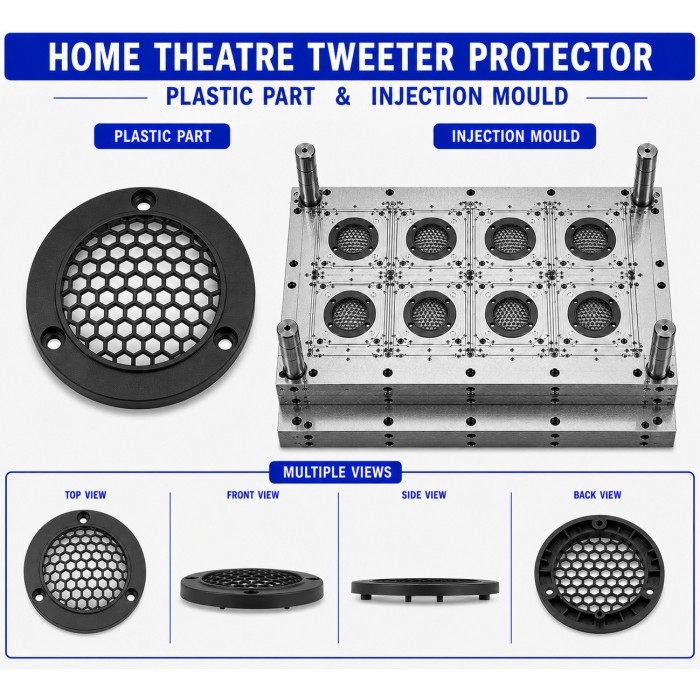
Home Theatre Plastic Tweeter Protector is a precision injection-moulded protective component fitted over or around the tweeter section of a home theatre speaker. Its primary purpose is to protect the delicate tweeter diaphragm and internal speaker elements from accidental contact, dust, impact, and mechanical damage while allowing sound to pass through the required openings.
The protector is designed around the actual tweeter dimensions and can include a perforated grille, acoustic openings, mounting clips, screw holes, locating ribs, snap-fit features, and protective surrounding walls. The opening pattern and thickness are developed so that the protector provides physical protection without unnecessarily restricting the tweeter's intended sound output.
Renovator Appliances Ltd provides complete Home Theatre Plastic Tweeter Protector Mould and Moulding Services, including product development, mould design, precision mould manufacturing, mould trials, plastic injection moulding, dimensional inspection, fitment testing, and bulk production.
Key Features
The Home Theatre Plastic Tweeter Protector provides a protective barrier around the tweeter while maintaining the required acoustic openings. Its perforation pattern, opening size, wall thickness, and grille structure can be customized according to the tweeter's design.
The protector can be manufactured with circular, rectangular, hexagonal, or customized acoustic openings, depending on the speaker design. Snap-fit clips, locating pins, mounting tabs, or screw-fixing points can be integrated for secure installation.
The surrounding structure can also be reinforced with ribs where required to prevent deformation during assembly and normal use. The component can be manufactured in different colours and surface finishes to match the speaker enclosure.
Industrial Applications
The Home Theatre Plastic Tweeter Protector is used for physical protection of tweeters and high-frequency speaker drivers in audio equipment.
Typical applications include:
Home Theatre Speaker Systems
Tweeter Speaker Assemblies
Surround Sound Speakers
Satellite Speakers
Soundbar Systems
Multimedia Speaker Systems
Bookshelf Speakers
Audio-Video Equipment
Premium Speaker Assemblies
OEM Audio Equipment
The exact protector design depends on the tweeter diameter, diaphragm position, required acoustic opening area, mounting method, speaker grille design, and available installation space.
Manufacturing Process
The Home Theatre Plastic Tweeter Protector is manufactured through plastic injection moulding.
The product design is first developed according to the tweeter's outer dimensions, diaphragm clearance, mounting arrangement, acoustic openings, and speaker enclosure geometry.
The selected thermoplastic material is processed according to its required moulding parameters and injected into the precision mould cavity. The cavity forms the protector's grille pattern, outer frame, mounting tabs, snap-fit features, locating ribs, and other required details.
After filling and packing, the component is cooled to achieve dimensional stability and then ejected from the mould. Any required trimming is performed before inspection.
The finished protector is checked for opening dimensions, tweeter clearance, mounting accuracy, warpage, flash, surface finish, and speaker assembly fitment.
Mould Manufacturing Process
The Home Theatre Plastic Tweeter Protector Mould is designed according to the protector's grille pattern, outer dimensions, mounting features, wall thickness, production quantity, and required mould life.
The mould incorporates the required cavity, core, parting line, gate system, cooling channels, and ejection mechanism.
Special attention is given to the small acoustic openings because these features must be formed accurately and consistently. Depending on the grille geometry, appropriate core pins and mould inserts can be used.
If the protector includes undercut snap-fit features, slides or lifters may be incorporated into the mould.
Mould components are manufactured using CNC machining, EDM, drilling, grinding, and precision finishing. After mould assembly, trial moulding is performed using the selected plastic material.
Trial parts are inspected for grille opening dimensions, tweeter clearance, mounting features, ejection, flash, warpage, surface finish, and assembly fitment. Required mould corrections are completed before production.
Raw Materials
The material for a Home Theatre Plastic Tweeter Protector should provide adequate rigidity, impact resistance, dimensional stability, and surface quality.
Depending on the design, ABS, HIPS, PP, PC-ABS, or PBT can be considered.
ABS and HIPS can be suitable where a rigid and aesthetically finished speaker component is required. PP can be considered where lightweight construction and impact resistance are important, while PC-ABS or PBT can be considered where higher mechanical and temperature performance is required.
The final material should be selected according to the required impact resistance, tweeter protection requirements, grille geometry, operating temperature, vibration, dimensional tolerance, colour, and customer specifications.
Quality Control
Quality control for the Home Theatre Plastic Tweeter Protector focuses on both physical protection and accurate fitment around the tweeter.
The component can be checked for overall diameter, height, frame thickness, opening diameter, grille-opening dimensions, wall thickness, mounting-hole position, clip dimensions, and tweeter clearance according to the approved drawing.
The grille must be free from blocked openings, short shots, excessive flash, broken ribs, cracks, and deformation, because these defects can affect both appearance and the intended acoustic opening pattern.
The finished protector is also inspected for warpage, sink marks, burrs, surface defects, and mounting fitment. Assembly testing can be carried out using the actual tweeter to confirm that the protector does not contact or interfere with the diaphragm.
Production Capacity
Production capacity depends on the product size, product weight, mould cavity count, cycle time, plastic material, injection moulding machine capacity, and production efficiency.
For example, a 4-cavity mould operating at a 20-second cycle has a theoretical capacity of approximately 720 pieces per hour before inspection, handling, downtime, mould maintenance, and other production losses.
For high-volume requirements, multi-cavity tooling can be considered where the grille geometry and moulding process permit it.
The final production capacity should be established based on the actual product weight, cavity count, cycle time, machine capacity, and required monthly production quantity.
Buyer Guide
Before ordering a Home Theatre Plastic Tweeter Protector Mould and Moulding Service, the buyer should provide a 2D drawing, 3D CAD model, tweeter sample, or existing protector sample.
Important specifications include tweeter diameter, tweeter height, diaphragm clearance, protector dimensions, grille-opening size, opening pattern, wall thickness, mounting method, clip arrangement, screw size, plastic material, colour, surface finish, dimensional tolerances, and production quantity.
If acoustic performance is important, the buyer should also provide the required grille opening pattern or acoustic design specification so that the protector can be developed according to the intended speaker performance.
Why Choose Renovator?
Renovator Appliances Ltd provides an integrated manufacturing solution for customized plastic speaker components used in home theatre, soundbar, subwoofer, amplifier, and audio-video equipment.
For the Home Theatre Plastic Tweeter Protector, our service can cover the complete process from product development and mould design to precision mould manufacturing, injection moulding, quality inspection, tweeter fitment testing, and bulk production.
The protector can be developed according to the customer's actual tweeter assembly, including specific diameter, clearance, grille opening pattern, mounting features, material grade, colour, surface finish, and production quantity.
This integrated approach helps maintain consistency between the tweeter dimensions, protector geometry, grille openings, mould, plastic material, and final speaker assembly.
Frequently Asked Questions (FAQ)
1. What is a Home Theatre Plastic Tweeter Protector?
A Home Theatre Plastic Tweeter Protector is a moulded plastic protective component fitted around the tweeter to help protect its delicate diaphragm from accidental contact and physical damage while providing the required sound openings.
2. Which plastic materials are suitable for a Tweeter Protector?
Depending on the design, ABS, HIPS, PP, PC-ABS, or PBT can be considered. Material selection depends on rigidity, impact resistance, dimensional stability, appearance, and operating conditions.
3. Can the Tweeter Protector be customized?
Yes. The protector can be customized according to tweeter diameter, height, diaphragm clearance, grille pattern, opening size, mounting arrangement, snap-fit features, colour, and surface finish.
4. Can the grille opening pattern be customized?
Yes. The protector can be manufactured with a customized opening shape, opening size, grille pattern, and open-area arrangement according to the speaker design and required acoustic specifications.
5. Can Renovator manufacture both the Tweeter Protector mould and finished components?
Yes. Renovator can provide complete mould manufacturing and plastic injection moulding services, including mould trials, dimensional inspection, tweeter fitment testing, and bulk production according to customer requirements.
Home Theatre Plastic Parts
Mould Material : P20 Steel / H13 Steel / S136 Steel
Plastic Grade : Engineering Grade / Impact Resistant Grade / Flame Retardant GradeProduct Material : ABS / HIPS / PP / PC-ABSMould Type : Single Cavity Mould / Multi Cavity MouldWeight : 10–80 gDimensions : 40–150 × 40–150 × 15–60 mm